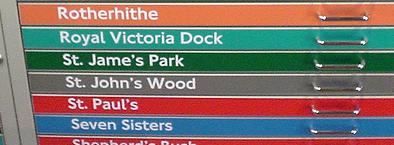
Thanks to DG for spotting this. There are two ways it could be spelt, opinions vary, but this is not one of them. (for that matter, there are two ways “spelt” can be spelled as well.)
 Speechles’s
Thanks to DG for spotting this. There are two ways it could be spelt, opinions vary, but this is not one of them. (for that matter, there are two ways “spelt” can be spelled as well.)
Renault Laguna – maintenance warningThanks to Andy who commented on my first Laguna posting, I now know how to reset the flashing spanner on the dashboard that tells me that it is time for a service. This is set to come up every 18,000 miles and some independent mechanics don’t know how to reset it.
With the key in the ignition (it doesn’t matter if the engine is running) press the button on the end of the stick to scroll through the trip computer settings. The one you want should have a static spanner and the number zero and is the seventh (and last) one from the start.
Now press the reset button on the dashboard and hold it in. After a few seconds it will flash and then reset to 18,000.
This is correct at least for my 2001 model.
Identity credentialsThere are three well known factors than can be used to establish a personal identity (this word is used here as a relative not an absolute i.e. who you are with respect to the service you wish to obtain).
Using all three of these becomes “three factor authentication” the holy grail of identity management.
The caveat of “relative identity” is important because people hold a number of separate identities at different times and places. For example at one moment you may be “mummy” and at another, “teacher.” In the shop you would be “customer” and at work “employee.” It is important to note that these are truly independent and don’t need to relate to each other in any way nor require the same degree of authentication.
In many cases reputation plays a key role. If you are behind the counter and the sign over the shop says “Jones—Butcher” then it matters not at all if your name is really Jones, but if you serve good meat then customers will come back with confidence. If someone else takes your place they will be less sure. Similarly if next day you are in the Bakery, then you will need to establish your reputation again before they will trust your bread.
Each of the first two factors have serious weaknesses when used on their own. Passwords can be forgotten, disclosed or compromised requiring an elaborate secondary mechanism for resetting them; cards can be lost, stolen or forged. Used together they are quite effective and form the mechanism of many well known authentication systems—ATM, chip and pin, Secure-id tokens and the better door entry swipe cards for example.
In theory the third, the “Are,” has the potential to be both an absolute (unique in the population) and sufficient (for the same reason) but in practice obtaining and validating such a metric is often beyond the capability of the systems available. Thumb prints have been used for login to a lap-top or starting a car for instance, but the experiments with facial recognition have been a disaster.
The factors are only valid if they are kept completely independent of each other. It becomes meaningless if you tattoo your password on your hand or store your finger-print on your passport but an exceptions are made, e.g. a photograph (a weak “Are” factor) on an employee id card ties the card to the person before using it to gain entry. This guards against loss or theft (to some extent) but not forgery; for that you need to ensure the uniqueness of the document. At validation this would mean comparing a master copy with the one presented, a relatively simple account lookup. For issuing new documents it means cross checking against all others issued, not just the person standing in front of you; this is a much harder empirical search.
Let us consider some traditional and modern examples. I have selected a few to illustrate both the wide variety of situations where we evaluate identity and the different means and rigour by which we do it.
Let’s look at correspondence; try a telephone call—the recipient may be partially identifiable in respect of having answered the call but the caller is anonymous (disregarding caller-id) unless they give you a name. Voice “Are” identification is not reliable even for people we know well. This explains the lengths the credit card company will go to establish who you are before discussing account details. Face-to-face conversation is little better, you have only substituted another unreliable “Are” factor, your face, but that is about all unless you can identify them from another source. A chat room/forum is even worse, the law may now require proof of age (somehow) for obtaining an account but little else. Your tag (name) is your own choice and there are no secondary means of identification. Try an email; even with ISP or domain addresses, the only requirement is that the user pays the bill. The service provider will know rather more but will only reveal it when legally obliged. Disposable email addresses are available which are not tied to anything. Perhaps you should write a letter; A name is now tied to a house address (an unusual “Have” factor) which needs to be valid because without it you won’t get a reply. There may be a signature but there is often nothing to validate it against. BUT—the question to ask is does it matter? No, not always! If you get an email of thanks for a helpful web page, does it really matter who sent it? Would they have sent it if they had to positively and absolutely identify themselves?
Other examples are financial transactions: You have an account number; depending on how secret this is kept this can vary from a “Know” factor to virtually useless. The Americans have hit this problem with their Social Security Numbers. It can be used to authenticate that the account owner is entitled to the service but not that the person giving the number is that person so requires additional verification. On a cheque, the signature is a very weak “Are” factor which, in theory, is validated against a master copy held by your bank or in association with the “Have” factors, the guarantee card and pre-printed cheques. Use your credit card then you “Have” the card and you “Know” the pin (or on old systems you use your signature which is, in theory, verified from the card). But if you are not present, by phone or web site for instance, then you “Have” the card but have to prove it by giving the secondary security number. How about cash; this is the best known of the “Have” tokens. It doesn’t matter at all who you are, only that your authority—the ready cash—is valid. Extraordinary measures have been take to ensure that it is hard to forge. At the extreme is the contract which requires identifiable witnesses present who know you and are prepared to vouch for your identity. They may also be required to be recognisable members of a community such as professionals.
Now you could argue that a simple National Identity Card would solve all of our problems but that would be to disregard my early point that the absolute and incontrovertible identity that this would attempt to give is not always necessary or desirable; and at what cost? After all, it is only a single factor “Have” token which attempts by some magic to connect itself to your “Are” existence by means of biometrics. None but the blinkered are convinced that this is even possible beyond the photo-id and signature we already have.
No truck with RBoSDuring the industrial revolution a practice sprung up amongst unscrupulous bosses of paying wages in tokens forcing their employees to use company shops for their provisions, both work-wear and tools and also domestic stuff like food. These were often poor quality at extortionate rates and were manipulated so that the workers never built up savings to enable them to better themselves. A series of laws were introduced to put a stop to this practice. The 1725 act required employers to use coin of the realm and the 1831 act stopped the practice in many trades and virtually all were protected by the 1887 act. Navvyman by Dick Sullivan has a good chapter on the subject. That didn’t necessarily stop the practice; intimidation of workers and forcing other local traders out of business was not uncommon.
It looks like the Royal Bank of Scotland is trying on something similar by forcing their staff to use an in-house bank account. There is no suggestion that there is any profiteering, traditionally bank employees have obtained financial services such as mortgages at a discount, but the practice is still against the spirit of the law if not the letter. It would be very prudent of an employee to hold their savings in an account separate from their employment so that in the unlikely event of a failure, they don’t lose out on both sides. In the same way it is not wise to invest too heavily in company share schemes.
Security HeresyYou are better off writing a good password down rather than memorising a poor one.
I have already posted the method I use for managing passwords but this relatively high-tech solution is not for everybody. I am not advocating the “post-it on the monitor” that the cartoon in the last post was talking about, but for those important passwords that you don’t use often and can’t remember, write them on a slip of paper and put them somewhere safe. This is a much better plan than using a silly password that anyone can guess.
The point is that everything deserves just the right amount of security. Providing any more is counter productive. You have to balance the potential loss against the risk and take into account the inconvenience; if it is too difficult then you won’t stick with it.
Some accounts don’t need much security at all—a simple password will do for subscription news accounts and you can safely let the browser remember them and automatically log you in (but write them down anyway in case you have to change machines). Most shopping accounts are similar, but email and forum accounts need a little more care because your reputation could be at stake. For financial & eBay passwords make sure that they are good and random and keep them very safe somewhere. If you need an email account on the road then the safe place could be as simple as your wallet. This is not a good place for your online banking account however, as there is a lot of other information in your wallet to help the thief. For most systems an adequate place is a notebook in another part of the house from your PC; you are hardly ever going to use them. And, as I said before, make sure that your heirs know where they are.
Password Reminders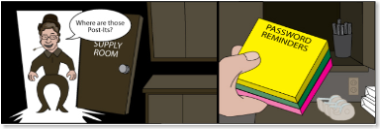
Thanks to the Security Buddha for this.
Fake 20sThese are the guidelines given in a press release from the Bank of England (PDF) about the new “Adam Smith” £20 note.
What should I do if I think I have a counterfeit note?
Counterfeit notes are worthless. It is a criminal offence to hold onto or pass on counterfeit notes. If you suspect a note is counterfeit, take it to the police as soon as possible. They will give you a receipt and send the note to the Bank of England for analysis. If the note is genuine, you will be reimbursed.
That last sentence doesn’t exactly encourage you to look too carefully does it?
Waste not, …As my family will testify, I am rather obsessive about waste. I think this is learned behaviour from my father and grandmother who taught me from a very young age what it meant. I can probably count the occasions when I have left food on my plate and then it was either because I was ill or the victim of over generous restaurants (which I will never visit again). I have also been known to cadge unwanted morsels from other people which probably makes me an embarrassment in company. It is hard sometimes not to berate others who leave perfectly good meals, don’t be surprised if I no longer talk to you if you are guilty. I will turn off television programs where waste or destruction is a feature of the entertainment. I have been known to cry in extreme cases, such as the Jersey tomato wars (yes, they are seared in my memory) or when our almost new car was written off. It may also account for why I am a little larger than I ought to be (if it is served then I will eat it) and why our house is full of things that “may come in useful one day.”
So I could probably answer today’s reported survey honestly and say that “No, I don’t waste food” unless you count over-eating as waste, which we probably should. By the way, you need to read the referenced article carefully. Half of the waste they are talking about is genuine rubbish; peelings, bones and used tea bags for instance. I am not interested in the environmental bandwagon that this report is hanging on but the fundamental principle that we should only consume (in whatever way) what we need. Anything else is theft.
There are sources of waste which never even reach the customer and the report doesn’t mention them. Food is trimmed so only the presentable bits are left in the packet, even though the other parts are good, and, even if not consumable, serve to protect the remainder. Use-by and Sell-by days often err on the ridiculously cautious side. We know, in most cases, what is good and what is bad and when we can’t, crying wolf too often only makes things worse. In what way will salt or sugar go bad (if kept dry).
“There’s nothing wrong with mouldy cheese, just cut the mould off”
“I remember in the old days, when you got a big joint on Sunday.
You’d have cold meat on Monday, cottage pie or shepherds pie on Tuesday, curry on Wednesday and so it would go on until you got a bit of fish on Friday.”
Don’t people still do that? We do.
2 Ways to Live
A simple and straight forward presentation of the Gospel.
Black armband| Trident |

Order of the Bath is powered by
WordPress
Theme "Bathtub" by Rick Parsons
Entries (RSS)
and Comments (RSS).





 Webmaster