
Archive for the ‘Miscellaneous’ Category

TapChild Poverty

14 Feb 2007 12:27 by Rick

Today’s top news story is the Unicef report (summary) that marks the UK as bottom of 21 developed countries regarding children’s “well-being.” This is certainly something to worry about and I have no argument with the findings; I have no intention of being an apologist for the poor state we find ourselves in. I am sure that they have done the analysis carefully and I would not expect any bias coming from Unicef. Nor do I criticise the report for not considering the problems, many of them are described in the report, in fact it goes on at great length about the shortcomings of the data and methods; but not in the media summaries.

A difficulty I highlight is with one of the metrics, that of poverty, part of the Material Well-being category. This is defined as the percentage of children living in homes with equivalent incomes below 50% of the national median. Now this is a useful measure to see how well your welfare reforms are going, but is meaningless when comparing countries with different income ranges and different costs of living. In a country with low incomes and high cost of living then the households in this category are going to be very poor indeed. But reverse the situation and they will be quite comfortable even though they are less well off than their immediate neighbours. Countries with a good score in this respect reflect a greater equality but not necessarily a better standard of living. I see that on page 6 they acknowledge this criticism.

Another interesting question arises when you look at the number of children living in these homes. It would be revealing to know why there are more children in these below 50% median households. Are the poor in Britain having relatively more children than in, say, Denmark which is at the top of the table? If so, why? I think a flaw in this measure is that there are too many variables and not enough is known (or reported) about the relationship between them.

A second criticism is that a lot of the measures are obtained by asking the children. This will give a good subjective view of their well-being, how well they feel about themselves, but does not give an objective view of how well off they are, even in more subjective areas such as happiness. A content child (or perhaps especially a content child) will find small things to be unhappy about and the report will be swayed by how articulate they are about expressing them. There is a note in the appendix (p47) that this data may not be good for the UK and Belgium but I can’t find the section it refers back to.

A third criticism is that this may be a report on irrelevant detail. What I mean is that we may all be doing very well or very badly and this report just shows the ripples on an otherwise good or bad performance overall. You need to watch the scales on the graphs; as is common to emphasise a point, many of the percentage scales do not run from 0-100 and can exaggerate the discrepancy. It would be good to see how some of these measurements compare with undeveloped and developing countries. That may indicate how much more effort we need to put into helping those children rather than ironing out the minor differences between children in our own society.

Even though the report is 50 pages long it is well worth reading, maybe just dip into some sections. My conclusion is that this is a very valuable report, but it asks very many more questions than it answers.

Child Poverty in Perspective: An Overview of Child Well-being in Rich Countries (PDF 1.5MB)
TapEmergency!

8 Feb 2007 09:42 by Rick

If you need an ambulance while on holiday in the Algarve, what number do you call. If you see a fire in a EuroCamp, how do you contact les sapeurs-pompiers? If your wallet mysteriously disappears in Barcelona, how do you ring the Guardia Civil? (even though they couldn’t help you)

The answer is surprisingly simple, DIAL 112, but not well known. Since 1991 this has been the standard emergency number in Europe including Britain. All the countries have their local numbers but, in theory they will be phased out. I can’t imagine 999 going out of use in a hurry!

112 is also the international emergency number on GSM mobile phones, though not other networks.

Many countries accept the well known emergency numbers for other states as well. e.g. New Zealand’s national number is 111 but they accept 000 for the Australians, 999 for the British, 911 for the Americans and now 112 for Europeans.

TapMobile Scam?

6 Feb 2007 11:26 by Rick

I’ve been getting a lot of odd incoming calls on my mobile recently. They ring strangely and on the screen it says they are data calls. If I answer them I get modem type noises so I have stopped bothering. I have a very low function brick so maybe they are photographs or ring tones or something like that.

They all come from 01772 208600 so I did a search on that and it seems he same number is used by a rogue outfit called Blue Bamboo in Preston, Lancs. who cold call people to get them to buy upgrades to their Orange contract. It is not going to work this way on me, but perhaps the idea is to persuade me to ring them back. Be warned!

Note: this situation has moved on since the original post was made so do read to the end of the comments before jumping to any conclusions.

TapPrivacy, what privacy?

09:20 by Rick

I always find it interesting how single minded the news reports can get when there is a big story about. At the moment one of the big stories is the outbreak of avian flu at the Bernard Matthews turkey farm in Suffolk. In a radio article it was reported that one of the workers (probably a Portuguese migrant) said how good the bio-security was “they even have cameras in the wash-rooms to make sure that you are cleaning up properly.” I am sure that if this was revealed in any other circumstances it would have been picked up and made a major story in its own right; would anyone, not desperate for a job at any price, tolerate this sort of intrusive surveillance?

TapMessage of Hope

5 Feb 2007 10:04 by Rick

This message from the Beachy Head Chaplaincy Team is a masterpiece of minimalism. They have captured the essence of Christian Hope—that it is coming soon. Thanks to DG for leading me to this.

TapCat litter

2 Feb 2007 15:19 by Rick

It seems that the trays that you put the contents of your pockets, shoes and anything else small into at airport security are actually cat litter trays!

TapSignature blocks

30 Jan 2007 12:52 by Rick

Signature blocks are the pieces of boilerplate text that are added to the end of every email that you send. Some are very small e.g. “cheers, Rick” and some, like corporate ones, are very big.

I consider it important that they contain a certain minimum of information; the reader needs to know who you are. First, for technical reasons, every signature block should begin with a line that contains two hyphens and a space "-- " at the start and nothing else. This is required by the email standard and allows client software to know when the content ends and the signature block starts. Many products take advantage of this and, for instance, display the signature in different colour.

The second essential item is your name. If you use multiple blocks and select each one according to the type of email, then this can be just your nickname or your full name and formal title according to circumstances, but if you use one block for everything then make sure that it is sufficient to pick you out from the crowd.

Include your email address. I know that there is a return address in the headers but in some circumstances, e.g. if the mail is forwarded, this can get stripped off.

Finally make sure that the block is appended to all mail—original notes, replies and forwards.

Putting large graphics and logos into signatures is considered bad form but other contact details can be very useful. I think I am unusual but I have always included my full address, telephone number, email address and web site URL in every email I send. There used to be a netiquette rule that 4 lines were the maximum but you can go over that if it is informative, just don’t overdo it.

The requirements for company emails are different and the (UK) regulations have just changed. You are now required to show the company name, registration number, place of registration and registered office address, also your VAT number if you have one. It is also recommended to include membership of any professional or trade association. Most companies are telling their employees to include this information on every email, internal or external, whether or not it is a formal communication, just in case they should be interpreted as such and leak to the outside.

On business emails there are often two other wordy blocks of legalese. The confidentially clause which tells you not to read the message if it wasn’t intended for you; a bit late that one as they are almost always after the content so you have just read it. Even so they are considered worthwhile as they should serve as a brake to forwarding them on to other people. If you really want to keep your messages confidential, encrypt them.

The other is the disclaimer clause which says that you can’t rely on or trust anything you have just read; This is a complete waste of time as you wouldn’t have sent if if you didn’t mean it (I hope). They are also legally ineffective. If you really want your messages to be validated, then digitally sign them.

TapSkewed population

18 Jan 2007 22:55 by Rick

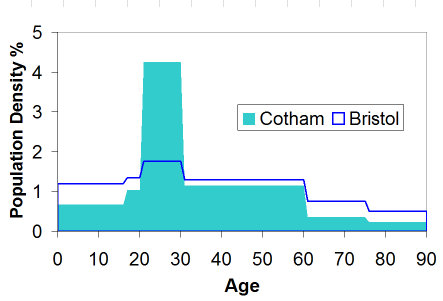
We are looking at future planning and direction in the parish at the moment. In the process we extracted the population demographics. We knew that this was heavily biased by the university influence but the extent of this came as a bit of a surprise. This is quite a challenge as the same graph drawn for church attendance would be very different.

Age distribution in Cotham ward showing a sharp peak in the 20-30 age band when compared to Bristol generally

TapElectoral Roll

17 Jan 2007 08:32 by Rick

It is time to reapply for the church electoral roll again. This comes up about once every 5 years or so. Rather than just tick the boxes and sign it I had a close look at the form (PDF) this time. It is very strange.

First you need to get the name of the parish right. If you are lucky this has been filled in for you as many are no longer obvious.

Declaration one is straight forward; aged 16 + and baptised. I was interested to note that there were no qualifications to baptism in any particular denomination or creed.

The second requires careful reading as it relates to three issues simultaneously—membership, of which more later; residence in the parish, this is not obvious unless you know your parish boundaries well; and regular attendance, which only applies if you live outside the parish.

In the footnotes there is a statement which talks about churches in communion with the Church of England which are only other Anglican and certain foreign churches. This struck me as strange as I thought the Methodist, Baptist and most other “ordinary” protestant denominations were in this category. Which prompts the question, what does it mean? I thought it was a mutual agreement that people who were in the practice of taking communion in one church were permitted to do so in the other. From this document it is restricted only to the Anglican Communion, not that this is actually a hindrance to joining the roll.

Going back to declaration two, the common feature of all the options is “a member of the Church of England”—now what does that mean? It is not what I am applying for here, that is just entitlement to vote at a particular local church annual parish meeting, effectively membership of the local parish church. Nor is it having been confirmed, that rite of passage performed when one reaches an age of discernment and you consider yourself a committed member. Confirmation is certainly not a requirement to be on the roll, or any other office in the church short of ordination that I can discover. Membership of the Church of England seems to be something rather ephemeral, it comes down to just turning up regularly. So the whole complicated declaration could be reduced to one of regular attendance and leave out the rest of the stuff with complicated doctrinal issues of communion and Trinity and that of residence.

TapOut of the closet

15 Jan 2007 08:41 by Rick

Until recently many hid their religion in the closet. They conceded that it was something private. Until a few years ago religion was similar to soft drugs: a blind eye was turned to private use but woe betide you if you were caught dealing. Only recently have believers realised that religion is certainly personal, but it can never be private.

Tobias Jones in the Guardian—quoted by Mat Ineson at St. Matthew’s on Sunday.

^ Top