Archive for the ‘Miscellaneous’ Category

TapReclaiming Xmas

25 Dec 2005 12:42 by Rick

I have always avoided using the word Xmas:

You are taking the Christ out of Christmas

people would say. Now I think, on the contrary,

  • The X stands for Christ and can mean nothing else.
  • It is a reminder of the sacrifice God made when he sent his Son.
  • It is a reminder of the destiny of the child that was born so innocent.

So use the word well and remember what it stands for.

I can’t see myself ever using Crimble however. That is taking the “mass”, the celebration, out of Christmas—I wonder why there is only one “s” on the end?

TapReview of 2005

23 Dec 2005 10:47 by Rick

This review is slightly early, but I have a free moment so what better time. Things have been very busy on the online front this year—these are just the ones I can remember:

  • The site was getting too busy—800–1000 visits per day according to the (unreliable) stats. This was overloading the free hosting I was using even with a bandwidth enhancement so the step was taken to purchase real hosting from the same supplier, DotEasy.com. So far it has been good though sometimes you have to nudge/bully them into doing the right thing.
  • 38 major new sections have been uploaded to West Penwith Resources thanks to the generous donation of material by others. This is compared to 20 in 2004. My own work has largely been reformatting but I have created some from scratch. There are now 821 solid pages of material.
  • An RSS Feed has been introduced as an alternative to the old page watch service. It is manually generated with similar content to the “What’s New” page; I can’t easily see how it could be automated.
  • The free search engine service provided by Atomz ran out of capacity and any externally hosted replacement was either too limited or too expensive. Now, having server side scripting available, I splashed out and bought a stand alone index generator and search script from Zoom. This has proved excellent, though a little slow to upload each time the site is re-indexed.
  • A comprehensive link check was done (blogged earlier).
  • This blog was added. I don’t think there are any readers, but that is not surprising as it is mainly a bunch of inarticulate rambling, but it gets it off my chest. Again, having server side capability, I used WordPress and customised a theme to my style, mostly by stripping out a lot of clutter. A few bits have made it back in as I discovered how useful they were but I am no fan of buttons and widgets distracting from the main goal.
  • The spammers have discovered the domain name (not just my active addresses) so I get hundreds of rubbish mails, mostly failure bounces where it has been used as a from address. Popfile is doing a good job of filtering them out but I am concerned about missing mail, particularly failures to deliver.
  • Losing mail is a continual worry. After a lot of effort I managed to resolve a blacklist dispute between DotEasy and Wanadoo but I still suspect that some stuff is not arriving when it should.
  • David has started work on a new version of HTML-Writer. I am looking forward to that as my needs outstripped the current version a couple of years ago. Even so, not bad for a 6th form school project.

Things that need to be done (next year?):

  • I am aware that WPR is rather drab looking. I have got used to it but it can’t be a good impression to new visitors—it needs brightening up but my graphic skills are lacking to do a good job of it. The requirements are a continuity with the past so as not to scare away existing users and to be mostly done in CSS so I don’t have to make huge changes to the 800+ old pages. Any takers?
  • The biggest bandwidth consumers are the CSS file (so it needs thinning down) and the custom “Old English” font that is used to add a little antique style to many pages. I don’t really know how well this works, probably only in IE, but I can’t think of a better way to do the job.
  • Finish the job of producing a dedicated print style sheet so that unnecessary navigation clutter is removed from printed reference copies of pages which many people like.
  • Finish transcribing Matthew’s History (but there is a long way to go), Kelly’s Directory 1919 (ditto).
  • Improve and complete the parish sketch maps. I have discovered some brilliant and free software to do the job, which will be the subject of another post; now I just need to get down to it.
  • WordPress 2.0 comes out on Monday 26th—Is it worth the upgrade and when?
  • Have another go at trying to spell check the site. Very hard as a) I can’t spell and b) neither could the writers of many of the documents transcribed. Finding a way to do it correcting my errors but not theirs is proving hard.

Offline things to do include investigating OpenOffice.org v2 and ThunderBird 1.5 (when it comes out) to try to detach myself from Office. I can then pass the 2000 licence on to others who need it. Will I ever detach from Windows—perhaps when Vista comes out?

That’s it for now—Happy Xmas everyone—deafening silence.

TapThe Price of Power

20 Dec 2005 18:50 by Rick

Once you become a manager, you’re always managing, whether you think so or not. Everything you say and do will be blown out of proportion and treated as the company’s official position rather than your own private opinion. Speaking of privacy, you won’t have any. Comments spoken in confidence will be in everybody’s e-mail by the end of the day. Sooner if they are negative. The price of power is giving up some of your personal identity. There is no point in feeling surprised or hurt by a phenomenon that is as predictable as gravity. Instead, since you will always be managing, learn to manage well. This means thinking before you speak, and considering the effects your words may have on other people. It also means living as if every one of your actions might be discussed at the next annual meeting.

That’s what they mean when they say it’s lonely at the top.

Albert Bernstein

Perhaps if all in management type positions, at all levels and in all situations, not just companies, realised this, then they would think more before opening their mouths.

TapServing Suggestion

10 Dec 2005 23:10 by Rick

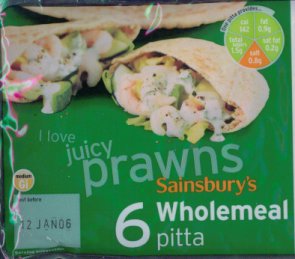
I love juicy prawns

Now that is ridiculous. Serving suggestion is one thing but when the largest ingredient on the list is not in the packet, that is something else.

TapSword of Truth

30 Nov 2005 11:30 by Rick

When listening to the disturbing news about the kidnapings in Iraq yesterday, I was suprised to note that the organisation claiming responsibility call themselves “The Swords of Truth.”

I always thought that this was a Christian expression quoting Ephesians but my memory was faulty though the principle is correct. Eph 6:14–17 has the belt of truth, coat of integrity, shoes of (the gospel of) peace, shield of faith, helmet of salvation and sword of the word of God (which is, of course, truth).

However is seems that lots of other people claim the Sword of Truth: Hindu, Fantasy Fiction, Earth observation satelite, Islam, Excalibur

TapScene 54—action

29 Nov 2005 13:02 by Rick

Why is it that Anti-Terrorist legislation is like a Dan Brown novel. You know; 400 pages each of which you have to read twice to understand in the context of the previous ones, but when you stand back, the whole idea is so silly that you may as well not have started.

So you put scanners at the entrance of major stations—your terrorist with two brain cells to rub together gets on at a suburban station and travels INTO town.

Broken plastic knives are very effective as threat weapons—so are pencils. It’s a pity that when you ask if there is a doctor on board that you have locked all his instruments in the hold.

Perhaps the guy with the rucksack talking to himself is one of the thousands that we have dumped on the streets and he needs someone else to talk to.

Remember, life is not a film script. You don’t have to invent something exciting for every scene.

TapLet us pray

21 Nov 2005 16:18 by Rick

The Lord’s Prayer as used in the Church of England

Over the past thirty years or so there has been a bit of a muddle over the wording of the Lord’s Prayer and I don’t think this serves either the regular congregation or the occasional worshipper at all well. It is only a small point but it is a part of the service which is most recognisable to the majority of people brought up in a nominally Christian background.

The reasoning for changing it is presumably to bring the language up to date, maintain a degree of continuity and keep the “poetry” of the familiar old version. I think that, after a few attempts, this has now been achieved. We should now go with it consistently and not keep changing our minds back to earlier versions because we think that people don’t know it.

There is a fallacy that the regular members know all the versions and that occasional or new worshippers are more likely to be familiar with older style versions. What is actually the case is that the regulars get muddled up between all the versions (I certainly do) and, although the basic form may lurk in the memory of the visitor, they certainly do not know the words any more and would be far more comfortable with a version they could understand. What is even more weird is quite often, the “traditional version” supplied is nothing of the sort.

These are the versions that are in common currency—some of the dates of introduction may be a bit out but I leave that to the liturgy pedants.

Book of Common Prayer 1662

This is the real traditional one—read it! How many people are really familiar with these exact words?

Our Father, which art in heaven, Hallowed be thy Name. Thy kingdom come. Thy will be done, in earth as it is in heaven. Give us this day our daily bread. And forgive us our trespasses, As we forgive them that trespass against us. And lead us not into temptation; But deliver us from evil: For thine is the kingdom, The power, and the glory, For ever and ever. Amen.

[The last sentence is omitted at some places in the book.] Ever since I have been a regular worshiper (35 years) small changes have been made e.g. “which” to “who”, “in earth” to “on earth” and “them” to “those”.

Now, with Common Worship (2000) we have FOUR versions.

Order 1(v1)

Our Father in heaven,
hallowed be your name,
your kingdom come,
your will be done,
on earth as in heaven.
Give us today our daily bread.
Forgive us our sins
as we forgive those who sin against us.
Lead us not into temptation
but deliver us from evil.
For the kingdom, the power,
and the glory are yours
now and for ever.
Amen.

This version was introduced and is unchanged from the Alternative Service Book 1980—Rite A(1), including retaining the Oxford Comma for some reason. We have used this for a long time and certainly our congregation likes it. It is clear and understandable; it flows and can be set to music if required.

Order 1(v2)

Our Father, who art in heaven,
hallowed be thy name;
thy kingdom come;
thy will be done;
on earth as it is in heaven.
Give us this day our daily bread.
And forgive us our trespasses,
as we forgive those who trespass against us.
And lead us not into temptation;
but deliver us from evil.
For thine is the kingdom,
the power and the glory,
for ever and ever.
Amen.

This version has only changed the punctuation from the Alternative Service Book—Rite A(2) , mostly adding semi-colons. It is this one that is often substituted in Weddings and Funerals when a “more traditional version” is required. It is not, it is a mangled mixture of archaic and modern language.

In addition there is Order 1(v3) which I first met in the experimental Series 3 Communion booklet in about 1975. It is similar to v1 but in place of “lead us not into temptation” it has “save us from the time of trial”—a totally different meaning and rather unbiblical (in my opinion). I don’t know why it was retained.

There is also Order 2 which uses the 1662 version but with small changes to the punctuation.

TapWho am I today

15 Nov 2005 11:41 by Rick

I have written about the silly/nasty/unworkable (delete as appropriate) ID cards system that the Government is trying to bring in. An article about Electronic Identity by Niels Bjergstrom looks at it from a number of interesting angles. The potential benefits, if it is done correctly are much greater than the headline grabbing ones the politicians mention, and include (to paraphrase) “enabling a better society.”

He also looks at the concept of identity and how it varies in different contexts but concludes that they all stem from a root identity obtained at birth, which is the only provable node in your life (and then, only in relationship to your mother, sorry dads.)

The conclusion is that the only reliable tag is an encrypted DNA code—it is verifiable and unique. But this is impractical/undesirable for regular testing except in the highest value cases (value here is not just monetary but could be privacy or other social value.) It can, however, be used to validate lesser biometrics and tokens for general day to day identification. A corollary I could add is that these lesser identities need not be unique so I can be Richard to my family, Rick to my friends, Richard John to the bank and “renowden” online without any suggestion of deception.

The drawback of going “back to roots” is that it takes at least a generation to implement and the best that can be achieved until multiple generations have passed (and for newcomers into the verified-ID zone) is that they are who they said they were at the point of entry.

TapPolitical conflict

8 Nov 2005 09:40 by Rick

Holding the political views that I do, which can be loosely described as “Christian Socialist,” I am very used to sometimes supporting the policies of one party and sometimes another. On the one hand supporting the traditionally right in policies of “family values” (horrible phrase) but also supporting the libertarian views of those that lean further to the left. It comes as no surprise, therefore to find myself supporting the appeal against the Health Ministry guidelines regarding information to parents about their children (I can’t find a news link at the moment).

It does, however, feel uncomfortable finding myself in opposition to this supposedly socialist government on issues of privacy, freedom of speech, and liberty. Uncomfortable being apparently on the same side as Boris Johnson and Anne Widdecombe (Widdy Web has no serious content). I have written on the subject of Identity Cards elsewhere and the Incitement to Religious Hatred Bill deserves more careful consideration but I have found my hackles rising in recent days with the attempt to deliberately remove a fundamental right of justice—that of the right to a trial before detention—known as Habeas Corpus. Yes I know that the police need to be able to investigate before bringing charges and I fully supported the rise from 7 days to 14 days for more complex cases which was brought in a couple of years ago. Stretching this to 90 days, or even 28, is way over the top. If they can’t find sufficient evidence for any crime in the time allowed suggests that perhaps the suspicion is unfounded. Since the 14 days was introduced, I understand that there have been no cases where a suspect released due to insufficient evidence has later been charged or even a warrant issued. You would think that the politicians would have learned from the failure of detention without trial regulations during the Irish troubles to try this tactic again.

TapMaking History

6 Nov 2005 12:53 by Rick

God put us here on earth to make history, not to watch history being made.

Revd. Canon Douglas Holt, today.

^ Top