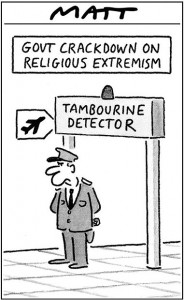
The Telegraph has a slide-show series of Airport Security cartoons.
 Airport Security
The Telegraph has a slide-show series of Airport Security cartoons.
Year for Change
Thanks to MyDavidCameron.com
A Disgrace to ParliamentIt is looking likely that at the next general election, whenever it is called but certainly before next June, that the current government will be deposed and Her Majesty’s Loyal Opposition will take over. It is therefore with dismay that I heard this offensive speech from a member who is likely to become a minister under that administration. I refer to a passage in which Michael Grove, Shadow Secretary of State for Children, Schools and Families, managed in one short paragraph (last paragraph) to offend a member of the public not associated with the debate and also to indulge in a form of humour which may be mildly amusing in a playground. Perhaps that is why his brief is for schools. Of course we knew what to expect when here he made a “joke” on the Secretary of State’s name—the lowest form of wit by any standards.
Have MercyPoliticians of the world seem to have trouble understanding the concept of mercy.
Scottish law provides for mercy in the power of the secretary of state on behalf of the government. Kenny MacAskill exercised his authority and explained in great detail that this was what he was doing.
Read Zechariah 7:9 and Matthew 5:7.
End of story.
ID Card Victory?The Home Secretary, Alan Johnson, announced yesterday that there was to be a change in policy and that Identity Cards were no longer to be made compulsory for any UK Citizens. This would abandon the trial for air-side staff at airports. They would, however, become compulsory for foreign nationals and the voluntary scheme was to be speeded up.
Does this make sense? Not really, as foreign nationals should have their own passports anyway so an additional card won’t make a lot of difference. There may be more of a case for people who have “mislaid” their papers.
Is this a victory? Well, partially. It is a clear indications of a steady back-pedalling by the government on the policy. You can no longer be required to produce it if there is no requirement to have one. There will no longer be an issue with lost or damaged cards or fines for failure to register.
However, there was no mention of the back-room ID Register. This will remain and be populated with information from passport applications. There is no indication that the amount of information required here will be relaxed at all. A passport, in theory, is voluntary but, if they can argue that digital television and broadband access are essential for daily living, then I can hardly see that passports can be regarded as optional.
My old (pre-blog) article on the issues is still largely relevant and, of course, No2ID.
Pirate Party A piece of news that has made no impact at all in the uk. The Piratpartiet (Pirate Party) has gained one seat in the European Parliament. They polled 7.1% of the vote in Sweden on a manifesto of Copyright Freedom and protest of the conviction of the Pirate Bay organisers earlier in the year. Their platform is not “make everything free” but more a call to consider the rights and needs of all the people, particularly in regard to Intellectual Property such as Copyright & Patents. When it is mostly the young that are caught up in this, no more is “I’d like to help you son, but you’re too young to vote” acceptable.
Arrggggh.
12 year sentenceJudge: The jury have returned their verdict and you have been found not guilty of all charges. I therefore sentence you to twelve years of suspicion; twelve years of wondering if there might be a knock on the door if you happen to have been near a place where a crime was committed; twelve years of being an automatic suspect for every new crime investigated.
This is what the ruling to retain DNA samples of people not charged or later acquitted of crimes means. The Home Secretary said “We will ensure that the most serious offenders are added to the database no matter when or where they were convicted” but these people were NOT convicted; in many cases they were not even charged.
There is talk of them extending the 6/12 year limit to fingerprints as well, but we know that is a joke—everyone’s fingerprints will be on the National Identity Database anyway.
Sub-primeI came across this little cartoon which explains what the crisis is all about (there is a part 2 as well).
Now the naive bit—the toxic assets, the sub-prime mortgages are people’s homes. They need somewhere to live. So if they default due to lack of employment or whatever then the houses now belong to the government (having bailed out the banks). The government announced a short while ago that there was a shortage of rental property—well there they are then!
BankersFor Christmas we received one of those tear-off daily calendars and this particular one is called Forgotten English about obscure ancient words. Below each definition is a short (vaguely) related article. With the discussions in the news about the responsibility of the heads of the banks, the one for last weekend was very appropriate.
clocking-hen
A sum of money put out to interest in a bank. Aberdeenshire. —Joseph Wright’s English Dialect Dictionary, 1898–1905Feast Day of St. Meingold,
a patron of bankers. American presidents have long held misgivings about the country’s banking system. In 1816, for example, Thomas Jefferson wrote to his old friend John Taylor, declaring: “I sincerely believe that banking establishments are more dangerous than standing armies.” In 1836, Andrew Jackson disbanded the second federal bank, remarking, “The bold effort the present bank made to control the Government…[suggests] the fate which awaits the American people should they be deluded into a perpetuation of this institution.” Later, speaking to the bankers, he was more blunt: “You are a den of vipers and thieves. I intend to rout you out, and by the eternal God, I will rout you out,” which he did. Even auto entrepreneur Henry Ford is said to have cautioned, “It is well enough that people of the nation do not understand our banking and monetary system, for if they did I believe there would be a revolution before tomorrow morning.”
© Jeffrey Kacirk
The lunatics are running the asylumOne is brought up with the assumption that those in charge are reasonably intelligent and to achieve government office you would need to be very bright indeed. I am sure that some of them are very smart, though don’t ask me to name one just at the moment.
So how did someone like the Rt. Hon Andy Burnham MP become Culture Secretary? I refer you to this interview in the Daily Telegraph late last year. Now, I don’t expect him to know everything, not even in his own portfolio, but the mark of intelligence is knowing when you don’t know and finding out by asking someone who does.
He clearly knows nothing about the internet; in fact, it looks doubtful if he has ever used it. So, just to help him out, here are some facts.
“It worries me – like anybody with children,” he says. “Leaving your child for two hours completely unregulated on the internet is not something you can do.
Right! It is not something you should do either. Learn to spend some time with your children.
To further support my argument, note that Andy Burnham previously worked for David Blunkett and Ruth Kelly when they were drafting the ID card ideas.

Order of the Bath is powered by
WordPress
Theme "Bathtub" by Rick Parsons
Entries (RSS)
and Comments (RSS).






 Webmaster