TapInternational Freephone

1 Mar 2007 13:57 by Rick

I imagine that, by now, most people will have experienced ringing a help line on what looked like an ordinary number, and finding that the call goes to India, Belgium or Ireland. This can also be true of traditional 0800 or 0808 Free Phone numbers. These are called ITFS (International Toll Free Service) numbers and are just forwarded to the real destination.

Another sort of number which has been slow to appear are true international numbers—called UIFN (Universal International Freephone Number) they start +800 i.e. from the UK they would be dialled 00800. The big advantage is that it is exactly the same number (except perhaps the + prefix) from most countries of the world which means that international businesses only have to publish one number.

Disadvantages are:

  • if your phone service blocks international calls, most of them don’t recognise that these are in fact free.
  • don’t try ringing them from a mobile; they are most certainly not free.
  • You have no idea where the other end is.

TapVista costs

28 Feb 2007 08:55 by Rick

This by Phil on our internal company blog

I see I can get Windows Vista Ultimate and Office 2007 Ultimate for the bargain price of £816.98 – a reduction of just over £150 on the list price of £969. But still the same price as two copies of a good Linux distro and OpenOffice – with the hardware to run them on thrown in for free…

TapAre you a British Citizen?

27 Feb 2007 12:40 by Rick

The question of citizenship has come up again because the heir apparent has said that new immigrants should do community service as well as pass a test.

This test is 45 minutes to answer 24 multiple choice questions and you have to achieve a score of 75%. Indirectly it also tests whether you can use a computer. It is actually much more a test of comprehension—have you read and understood the book—than knowledge, but in that respect I suppose it means that the candidates must have a good grasp of English (or Welsh or Gaelic).

The cost is £10 for the book and £34 for each attempt at the test. Most of the practice tests cost money, this is one of the few that doesn’t. Try it for yourself, this is how well I did.

  1. %age of population under 19—no idea but can make a sensible guess.
  2. Women’s vote—OK, I know that one.
  3. Causes of crime—again a sensible guess.
  4. Population—a sensible guess (that is the problem with multiple choice questions)
  5. Largest ethnic minority—I got this wrong.
  6. Census—well I ought to know this one having worked with it for a number of years.
  7. Religion—I got this wrong as well.
  8. Width of country—guess again but why expect them to learn obsolete units of measurement.
  9. Language—I would dispute “widely spoken”
  10. Sport—not surprisingly I got this wrong.
  11. Bank holidays—I forgot to count May Day.
  12. Easter Eggs—I have no idea and I don’t suppose many other people do either.
  13. Boxing Day—I know that, but celebrated is an exaggeration.
  14. Prime Minister—I got the answer right but technically it is wrong.
  15. Cabinet—I got this wrong.
  16. Lords—A good guess again.
  17. Queen—OK but again a technicality likely to trip up a foreigner.
  18. EU foundation—ignoring the spelling mistake, I have no idea. A random guess.
  19. EU size—I know that.
  20. Age for public office—I got this wrong.

The site failed to add up my score but I got 12/20 = 60%. When do I get deported?

TapRolling News

12:28 by Rick

We happened to switch on the TV at about 10pm on Friday to get some news and, on News 24, be landed in the middle of the story about the Cumbria train derailment.

Some observations I made at the time:

  • A major incident it certainly was, but it didn’t look serious enough to black out ALL other news both from home and overseas.
  • It was addictive—I felt that you had to hang on a little longer in case something important came to light.
  • It made the official spokesmen look stupid. They didn’t know what was going one, we knew more from mobile phone calls and pictures from people on the train.
  • They kept saying that, apart from a few people unable to move, there were only minor injuries.
  • The train seemed remarkably empty—only 120 people on a nine carriage Friday night express from London to Glasgow?

Now a few days later, some of my opinions have changed.

  • They were wrong—it was more serious that they knew. It goes to show that the people actually there don’t necessarily know what is happening.
  • The official spokesmen were not stupid, they knew that only had part of the information and were sensibly not committing themselves before they knew for certain.
  • The BBC executive reporting from the train should have known better. Her position gave her reports authority and weight which was not justified by the circumstances.
  • It calls into question how reliable any “on the spot” journalism is.

TapRandom

26 Feb 2007 12:53 by Rick

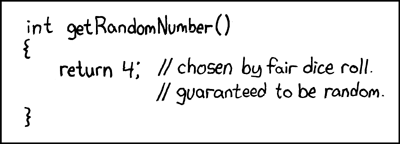
int getRandomNumber() { return 4; //chosen by fair dice roll. //guaranteed to be random. }

Thanks to XKCD

And a couple of classic random quotes

“Anyone who considers arithmetical methods of producing random digits is, of course, in a state of sin.” John von Neumann

“The generation of random numbers is too important to be left to chance.” Robert R. Coveyou

TapROFL

22 Feb 2007 08:50 by Rick

Sometimes you get a spam message that is so funny you can’t help laughing, mostly at their incompetence. Take this one which slipped through my filter; it looks like it is a multiple choice randomiser to generate basically the same message but each one with slightly different wording. At least, it would if it wasn’t for the fact that they have sent the source code not the generated text.

<“Hello”|”Hi”|”Hi there”|”Good day”>

I <“hope”|”sincerely hope”|”wish”> this message finds you in a great <“spirit”|”mood”>. <“For a start”|”First”|”First of all”> <“I would”|”I’d”> like to <“congratulate”|”welcome”> you on this <“offer”|”opportunity”> because our <“association”|”company”|”corporation”> just got your contact and your <“brief”|”short”> profile through an <“email”|”web”> listing affiliated with <“the UK Chamber of Commerce”|”Monster”|”Careerbuilder”|”Yahoo Jobs”|”Google Jobs”|”HotJobs”>
<“I would”|”I’d”> be <“very”|”extremely”|”highly”> interested in <“offering”|”giving”> you a <“work at home”|”great”|”flex-time”|”part-time”> <“job”|”career”> in which you <“could”|”can”|”would”> <“earn”|”get”> an extra income <“of about”|”nearly”|”up to”|”starting from”> J<“2000″|”3000″|”4000”> <“per month”|”monthly”>.

This work <“does not”|”doesn’t”|”will not”|”won’t”> affect your <“present”|”current”> <“job”|”career”> and this is a <“very “|””>limited offer in which I <“will”|”would”|”would really”> require your immediate response. I <“will be hoping”|”really hope”> to hear from you soon, since <“its”|”it’s”|”it is”|”this is”> a job that <“can”|”will”> enable you to <“work from home”|”work part-time”|”enjoy an easy work”|”work at home”>. You will also <“stand the chances”|”have a chance”|”be given the opportunity”> of being a part of our future and <“excellent”|”winning”|”our”> team in which <“you will”|”you’ll”> be highly <“appreciated”|”respected”>.
Please fill out our <“application”|”appointment”> form, <“no fees asked”|”no money upfront”>, just your <“name and a phone number”|”basic contact details”>:
[web address removed]

<“Your application”|”Your enquiry”> will be <“processed”|”answered”> <“as soon as possible”|”ASAP”>.

<“Thank you”|”Thanks”|”Have a nice day”|”Best wishes”|”Take care”|”Bye”>.

Soon afterwards I got the real thing!

TapLandline nuisance

21 Feb 2007 20:41 by Rick

We keep getting calls from 0803 969 3882. We have no idea who it is and they don’t ring long enough to answer. Please stop it.

TapAlphabets

20:04 by Rick

A correspondent (Colin) was reading my Cockney Alphabet page and was asking if anyone knew the rest of another one he has a snippet of.

F is for freedom, which England’s all about
If you can’t afford your dinner then you’re free to go without!

Apparently Tony Benn mentioned it on a radio program but doesn’t know any more. Does anyone know the rest?

TapVista Security

14 Feb 2007 12:56 by Rick

It has been asserted that “Vista is light years ahead” of Windows XP on security (sorry I can’t find the citation but it is quoted here).

Well we have a good test for that over the next few years. Let us see how many new vulnerabilities are detected in Windows XP and its accomplices which are not applicable to Vista.

TapChild Poverty

12:27 by Rick

Today’s top news story is the Unicef report (summary) that marks the UK as bottom of 21 developed countries regarding children’s “well-being.” This is certainly something to worry about and I have no argument with the findings; I have no intention of being an apologist for the poor state we find ourselves in. I am sure that they have done the analysis carefully and I would not expect any bias coming from Unicef. Nor do I criticise the report for not considering the problems, many of them are described in the report, in fact it goes on at great length about the shortcomings of the data and methods; but not in the media summaries.

A difficulty I highlight is with one of the metrics, that of poverty, part of the Material Well-being category. This is defined as the percentage of children living in homes with equivalent incomes below 50% of the national median. Now this is a useful measure to see how well your welfare reforms are going, but is meaningless when comparing countries with different income ranges and different costs of living. In a country with low incomes and high cost of living then the households in this category are going to be very poor indeed. But reverse the situation and they will be quite comfortable even though they are less well off than their immediate neighbours. Countries with a good score in this respect reflect a greater equality but not necessarily a better standard of living. I see that on page 6 they acknowledge this criticism.

Another interesting question arises when you look at the number of children living in these homes. It would be revealing to know why there are more children in these below 50% median households. Are the poor in Britain having relatively more children than in, say, Denmark which is at the top of the table? If so, why? I think a flaw in this measure is that there are too many variables and not enough is known (or reported) about the relationship between them.

A second criticism is that a lot of the measures are obtained by asking the children. This will give a good subjective view of their well-being, how well they feel about themselves, but does not give an objective view of how well off they are, even in more subjective areas such as happiness. A content child (or perhaps especially a content child) will find small things to be unhappy about and the report will be swayed by how articulate they are about expressing them. There is a note in the appendix (p47) that this data may not be good for the UK and Belgium but I can’t find the section it refers back to.

A third criticism is that this may be a report on irrelevant detail. What I mean is that we may all be doing very well or very badly and this report just shows the ripples on an otherwise good or bad performance overall. You need to watch the scales on the graphs; as is common to emphasise a point, many of the percentage scales do not run from 0-100 and can exaggerate the discrepancy. It would be good to see how some of these measurements compare with undeveloped and developing countries. That may indicate how much more effort we need to put into helping those children rather than ironing out the minor differences between children in our own society.

Even though the report is 50 pages long it is well worth reading, maybe just dip into some sections. My conclusion is that this is a very valuable report, but it asks very many more questions than it answers.

Child Poverty in Perspective: An Overview of Child Well-being in Rich Countries (PDF 1.5MB)

^ Top